About Us
The Canadian Association for Biological Safety/L’Association Canadienne Pour La Sécurité Biologique (CABS-ACSB) was formed in the 1990's as the Canadian affiliate of the American Biological Safety Association (ABSA). CABS-ACSB aims to establish a Canadian network of individuals interested in a wide variety of biological safety issues and to enhance the knowledge and understanding of biological safety.
CABS-ACSB is registered (since June 1990) as a not-for-profit corporation. Corporations Canada (https://www.ic.gc.ca/eic/site/cd-dgc.nsf/eng/home) provides a means to search for Directors, Annual Filings and Certificates of Continuance.
CABS-ACSB is also registered with Volunteer Canada (Membership ID 103918) (https://volunteer.ca/)
President's Message
Dear Members, both past, present and affiliates,
As we reflect on the past year, I am beyond proud of the dedication, expertise, and collaboration demonstrated by our members.
Together, we continue to advance biosafety and biosecurity practices across Canada while supporting one another through professional development, knowledge sharing, and networking opportunities. I would like to extend my sincere thanks to our volunteers, committee members, instructors, sponsors, and the Board of Directors. Our community is the foundation of our Association's success.
As the biosafety profession continues to evolve, CABS remains committed to supporting our members, promoting excellence in our field, and fostering a strong and connected biosafety community.
Looking ahead, the Association remains focused on supporting professional development, strengthening member engagement, and fostering the next generation of biosafety professionals. We are committed to enhancing the resources and opportunities available to our members while continuing to promote excellence in biosafety and biosecurity both nationally and internationally.
Thank you for your continued engagement and support. I look forward to the discussions ahead and to another successful year for our Association.
Sincerely,
Meghan Allen, President, CABS-ACSB
Our Mission
The Canadian Association for Biological Safety (CABS - ACSB) has adopted and, as a condition of obtaining and continuing their membership in this association, every member of CABS – ACSB accepts the Code of Ethics. In accepting the Code of Ethics, each member of CABS – ACSB pledges to subscribe not only to the letter but the spirit of the Code in all their professional activities.
Code of Ethics
To support and develop the profession of biosafety and biosecurity in Canada, and to share our expertise nationally and internationally.
Purpose
The purpose of the Code of Ethics is to provide guidelines to ensure that members of CABS – ACSB adhere to high ethical standards of practice.
The ethical relationships of members of CABS – ACSB are defined to ensure that their conduct will:
- Provide sound judgement in pursuance of their professional duties;
- Maintain the highest standards of integrity and professional competence; and,
- Uphold the honour and prestige of the association.
Professional Responsibilities
Directors shall:
- Not use membership lists for any purpose other than contacting the membership about matters relating to CABS – ACSB business as outlined in the By-laws of CABS – ACSB.
- Not permit the use of membership lists by members or any other organization or person, unless authorized by the board, and that use is for the purpose of contacting membership about matters relating to CABS – ACSB business as outlined in the By-laws of CABS – ACSB.
- Be bound by the membership responsibilities outlined below.
Members shall:
- Protect and promote the biosafety, biosecurity and health of humans, animals, property and the environment above any consideration of self-interest.
- Engage only in activities that maintain and enhance the quality of their professional service. This would include activities on List servers, social media sites, such as Facebook, Twitter, Linked-in, etc. and any other communication tools that may become available in the future.
- Avoid circumstances where compromise of professional conduct or conflict of interest may arise, including engagement in marketing and advertising products and/or services pertaining to Biological Safety unless authorized by the board. This includes presentations by members at CABS – ACSB sponsored events.
- Membership lists are not to be used for commercial or marketing purposes; the membership list is restricted to CABS-ACSB business.
- Be objective in the application of recognised scientific methods and in the interpretation of findings.
- Recognize and respect the original work, integrity and ability of their peers.
- Recognize their professional limitations and level of competence as well as the special skills of others in related professions.
- Continue professional development throughout their career and support and encourage fellow Association members to develop professionally.
- Protect the confidentiality of all professionally acquired information and disclose such information only when properly authorized or when legally obligated to do so.
- Represent their qualifications and experience accurately and not knowingly make false or misleading statements.
Breach of Ethics
A member who breaches the Code of Ethics may have their membership cancelled without further legal challenge.
CABS-ACSB Executive
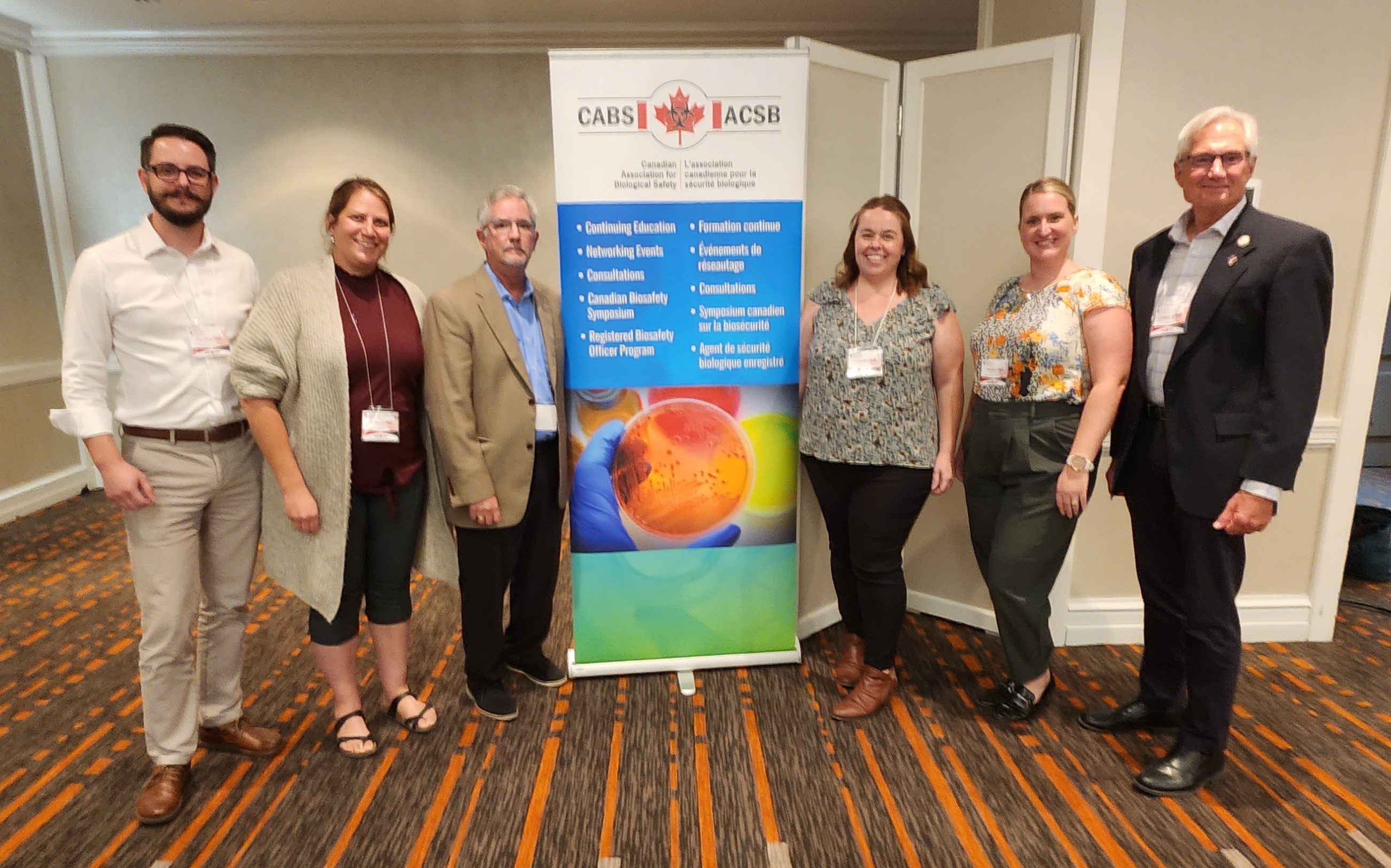
Left to right: Kirishanthy Kathirkamathamby (Elections Officer), Tanya Vlaskalin (Communications), Meghan Allen (President), Aurel Tamburri (President-Elect), Stefan Wagener (Member at Large), Tom Walus (Treasurer), Corrie Duchesne (Secretary/Social Media Officer) (Canadian Biosafety Symposium 2026).
The executive is the governing body of the Canadian Association for Biological Safety (CABS-ACSB). The executive consists of the President, Past President, President-Elect, Treasurer, Secretary, Communications Officer, Elections Officer and Member At Large.
Meghan Allen - President
Meghan completed her Bachelor of Science in Agriculture at the University of Saskatchewan in 2009, majoring in Food Science, and Applied Microbiology. Meghan spent the first years of her career in the food industry focused on quality assurance as well as research and development. In 2014, she shifted her focus from industry to the research sector, and joined the Canadian Light Source (CLS). Meghan’s role at the CLS began as a Biological Safety Coordinator, and has continued to expand into her current role, as the Biological, Chemical, and Occupational Health and Safety Lead within the Health and Safety Department. Meghan has also recently completed her Certificate in Occupational Health, Safety and Environmental Systems through the University of Fredericton. Meghan has been a part of the CABS Executive Team since 2020, beginning in the Secretary position, and now as President-Elect. She has enjoyed serving the Canadian biosafety community in this role, and is excited for the future development of the Association!
President-Elect - Aurel Tamburri
Aurel Tamburri is a science facilities strategist, laboratory operations leader, and biosafety expert with more than 25 years of experience in laboratory planning, design, commissioning, operational readiness, and facility activation.
His expertise spans biosafety and biosecurity, laboratory start-up, regulatory readiness, workflow optimization, equipment procurement, and the integration of automation and emerging technologies. He has led and supported major public health, research, academic, and high-containment laboratory initiatives across Canada and the United States, bridging facility design with the operational requirements needed to deliver safe, resilient, and high-performing laboratories.
Aurel has contributed to Canada's biosafety profession for more than two decades through education, professional development, and national leadership. He was the inaugural Chair of the Canadian Biological Safety Officer Network and, since 2020, has served as Chair of Canada's National Certification Committee for Polio Eradication. A long-standing CABS contributor, Aurel has delivered presentations, technical sessions, and workshops at CABS symposia for more than a decade on biosafety, facility design, threat and risk assessment, operational readiness, and emerging laboratory technologies. He has also presented and facilitated workshops for ABSA International and EBSA.
Aurel has held senior leadership roles with the Ontario Ministry of Health, Public Health Ontario, the University of Toronto, and Merrick & Company. He holds a Master of Health Management and a Graduate Diploma in Occupational Health, Safety and Environmental Medicine from McMaster University, a Diploma in Medical Laboratory Science from the Michener Institute, and is a Canadian Registered Safety Professional (CRSP).
Tom Walus – Treasurer
Tom Walus graduated from the University of Winnipeg and did his medical laboratory training at Health Sciences Centre in Winnipeg. He worked at HSC for over 20 years as a senior technologist responsible for mycobacteria and as the clinical instructor. He left Winnipeg for 2.5 years to go to Saskatoon to be the laboratory manager for clinical microbiology with the Saskatoon Health Region. He returned to Winnipeg to work at St. Boniface General Hospital as the clinical instructor. In 2014 he worked at the International Centre for Infectious Diseases as the program manager for biosafety. His current position is biosafety and biosecurity officer for Diagnostic Services Manitoba. Tom has been and continues to be involved in many professional societies. From bench to boardroom, from classroom to teacher…he has seen just about everything!
Corrie Duchesne – Secretary/Social Media
Corrie Duchesne is the Science Lab and Biosafety Officer at Canadore College, where she oversees biosafety, laboratory operations, and compliance across multiple science disciplines. With more than 20 years of experience in the laboratory field, she also teaches part-time in the Biotechnology and Medical Laboratory Technology programs. Corrie holds an Advanced Diploma in Biotechnology, a Bachelor of Science in Biology, and additional credentials in Adult Education, Public Health and Occupational Health and Safety. She is a Registered Biological Safety Officer (RBSO) with CABS-ACSB.
Kirishanthy Kathirkamathamby - Elections Officer
Kirishanthy brings over two decades of expertise in molecular biology, immunology, biosafety, and research safety management. She holds a Master of Science in Immunology from the University of Toronto and an Honours Bachelor of Science in Biochemistry/Biotechnology from the University of Waterloo, graduating with distinction. Currently serving as the Research Safety & Compliance Manager and Biological Safety Officer at Sunnybrook Research Institute, Kirishanthy oversees and provides directions for all safety programs for a research community of over 1,200 personnel. She is a Registered Biological Safety Officer with certifications in Joint occupational Health & Safety and Infection Prevention. She is also currently a member of the Public Health Agency of Canada’s Biocontainment Engineering Science Working Group. Her technical expertise is complemented by a strong academic research background and a demonstrated commitment to community leadership, including serving on the Sunnybrook Health Sciences President’s Anti-Racism Task Force and on being one of the board of directors for a non-profit affordable housing community land trust. Kirishanthy is a passionate advocate for advancing biosafety standards and fostering safe research environments. She aims to bring her insights and dedication to biosafety to CABs, helping the organization support biosafety professionals as they navigate the evolving landscape of biological research.
Stefan Wagener – Member at Large
Dr. Stefan Wagener is an international leader in biosafety, biosecurity, bioethics, and biorisk management. He is recognized as the originator of the “biorisk management” concept and is a global expert in biorisk management systems. After earning his M.Sc. and Ph.D. in Microbiology in Germany, he began his career in 1989 at Michigan State University as a research scientist, safety professional, and biocontainment specialist. In 2001, he moved to Winnipeg to become Chief Administrative Officer of Canada’s Biosafety Level 4 facility, later serving as its Scientific Director. He then held senior leadership roles with Health Canada, the Public Health Agency of Canada, the Canadian Food Inspection Agency, and the Canadian Grain Commission, retiring in 2019 as Director General. He chaired European workshops that produced the first global biorisk management standard (CWA 15793:2008) and its guidance (CWA 16393:2012), leading to ISO 35001:2019. He has advised the World Health Organization, Canada’s Department of Foreign Affairs, the Canadian Space Agency, and laboratories worldwide on biosafety, risk management, and policy. Since retiring, he has established global training platforms, founding the Biorisk Institute (2022) and Biorisk Management International Ltd (2024), which offers ISO 35001 Lead Auditor Training and develops AI tools for biorisk management. In 2025, he was appointed as Executive Director of the International Federation of Biosafety Associations. A certified Lead Auditor for ISO 17025, 45001, and 9001, he has extensive BSL-2 to BSL-4 experience. His leadership has earned him several honours, including the Everett Hanel, Jr. Presidential Award from the American Biological Safety Association, where he also served as president. As an Alexander von Humboldt Fellow, he continues to contribute to ISO standards and international biorisk management associations. Based in Malta and Canada, he is a respected international trainer, speaker, and executive coach.
Tanya Vlaskalin – Communications
Tanya is currently Manager of Radiation, Chemical and Biological safety at Toronto Metropolitan University. In this role she manages all high risk programs in research and teaching laboratories including the institutional hazardous waste and environmental emissions portfolios. She brings over 20 years of expertise in RP, chemical, biosafety, and research safety management. She is a Registered Biological Safety Officer with CABS-ACSB, a Registered Radiation Safety Professional with the Canadian Radiation Protection Association (CRPA), and Canadian Registered Safety Professional with the Board of Canadian Registered Safety Professionals. Tanya has been a member of CABS for several years and Past President and Director of the CRPA. She is also currently the Secretary of the CRPA Board of Directors. Tanya holds a Bachelor's of Science degree in Zoology from the University of Toronto and a Master's of Science degree in Molecular Medicine from the University of Ottawa. She also completed professional certifications in Occupational Health and Safety and Leadership in Organizations at TMU (formerly Ryerson University). For the past two decades, Tanya has used her knowledge and expertise in various capacities, sitting on local and federal working groups and committees to help shape best practices, guidelines and processes for legislative compliance and nonprofit organization operations.
Past Presidents
- Stephen Thiereault
- Stephane Bourget
- Lois Sowden-Plunkett (2008/09 to September 2014)
- Andrea Smida (September 2014 to 2017)
- Tom Walus (September 2022 to September 2024)
- Andrea Smida (September 2024 to 2026)
CABS-ACSB Bylaws
A pdf containing our CABS-ACSB Bylaws is available in both english and french for download
CABS-ACSB Bylaws(ENGLISH)
Règlements Administratifs CABS-ACSB(FRANCAISE)
Partners and Affiliates